
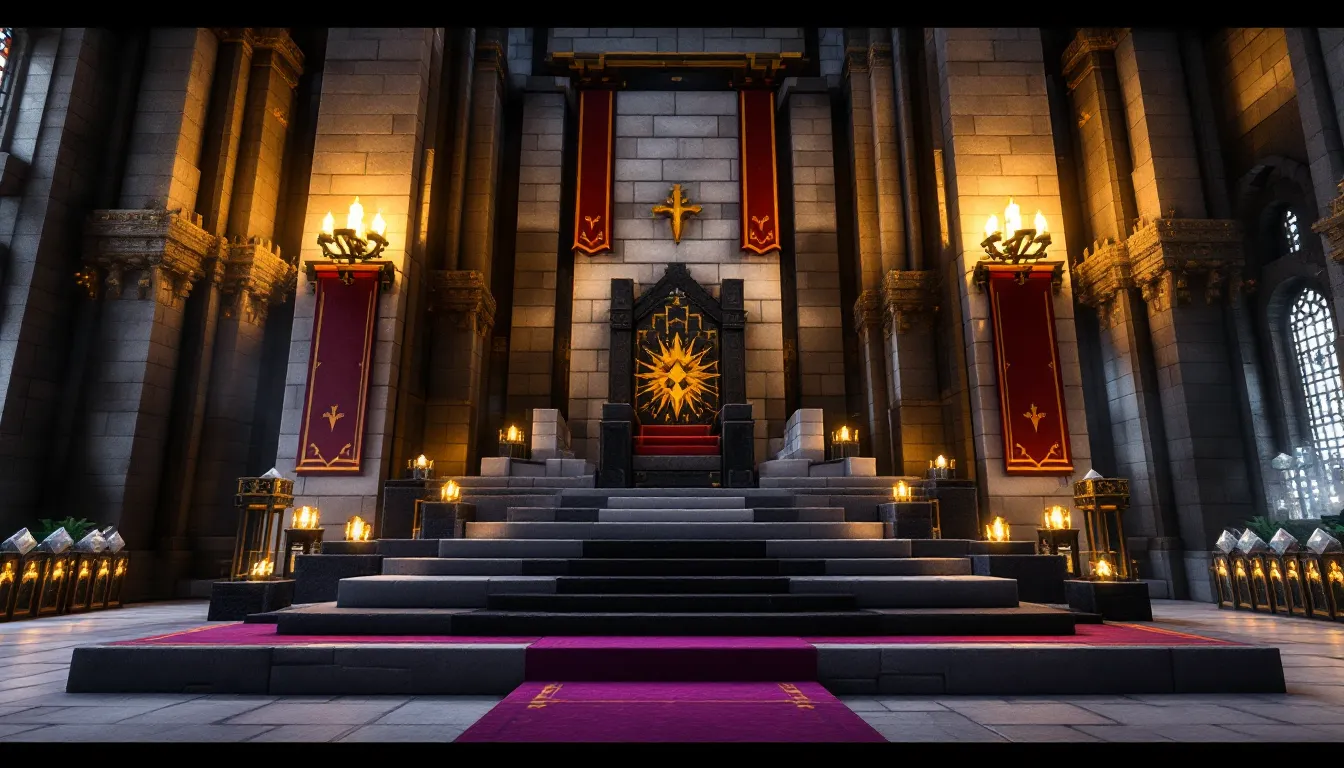
Every great Minecraft kingdom deserves a throne, not just for the aesthetic flex, but because it anchors your base with a sense of power and purpose. Whether you’re ruling over a medieval castle, a nether fortress, or a futuristic citadel, the throne is where you sit, survey your domain, and maybe judge your friends who died to fall damage again. Building a throne isn’t just about slapping down a few stairs and calling it a day. The best throne designs balance proportion, material choice, and surrounding architecture to create something that genuinely feels regal. In this guide, we’ll walk through everything from beginner-friendly stone thrones to advanced multi-level builds with custom pillars and detailing. You’ll learn which blocks work best for different themes, how to avoid common design pitfalls, and how to deck out a throne room that makes visitors stop and screenshot. Whether you’re playing vanilla 1.21 or running modded setups, these techniques scale to any version.
Table of Contents
ToggleKey Takeaways
- A Minecraft throne serves as both a symbolic focal point and functional anchor for large builds, teaching essential construction skills like symmetry, layering, and material contrast that translate to bigger architectural projects.
- Beginner throne builders should start with simple designs using stone bricks, stairs, dark oak fences, and carpets, which can be completed in minutes but still deliver an intentional, polished look.
- Material selection defines your throne’s aesthetic—medieval themes thrive on stone variants and dark tones, while futuristic designs benefit from concrete, quartz, and minimalist angular elements like iron bars and glass panes.
- Throne rooms should be at least 3× the width and 2× the height of the throne itself, with the throne elevated on a dias and surrounded by pillars, banners, and lighting to create a memorable, spacious environment.
- Avoid common pitfalls like building too small, ignoring symmetry, using monochrome blocks, and forgetting ambient lighting—instead, prioritize texture contrast, proper stair orientation, and hidden light sources like lanterns and glowstone under carpets.
- Themed Minecraft throne designs—such as ice and snow kingdoms, Egyptian desert styles, or jungle temples with vines and mossy stone—work best when they align with surrounding biomes and builds for cohesive world design.
Why Every Minecraft Kingdom Needs a Throne
A throne serves as the symbolic and physical center of any build that aims to feel lived-in and purposeful. It’s not just decoration, it’s a statement piece that tells visitors (or server mates) exactly who’s in charge.
From a design perspective, thrones anchor large builds. Castles, mansions, and fortresses can feel empty without a focal point. A well-placed throne draws the eye and gives players a natural destination when they enter your main hall. It’s also a functional seat for role-play servers, streaming setups, or just taking a screenshot after finishing a massive project.
Beyond aesthetics, building a throne teaches essential Minecraft construction skills: symmetry, layering, use of stairs and slabs, and integrating detail blocks like carpets, banners, and fences. Even a simple throne build forces you to think about scale and proportion, skills that translate directly to larger architectural projects. Plus, there’s something satisfying about sitting in a custom-built throne after grinding for hours to gather the materials.
Essential Materials and Blocks for Building Thrones
Choosing the right blocks defines the entire vibe of your throne. Medieval builds lean on stone variants, while futuristic designs might pull from concrete and metal-look blocks. Here’s what works and why.
Best Blocks for Medieval and Fantasy Thrones
Medieval and fantasy thrones thrive on texture contrast and earthy tones. Stone bricks (regular, mossy, cracked, and chiseled variants) form the backbone of most classic throne designs. Pair them with polished andesite or polished blackstone for darker, more imposing looks.
Stairs and slabs are non-negotiable, they let you create the actual seat and backrest. Polished blackstone stairs, stone brick stairs, and dark oak stairs all work well depending on your color scheme. For added detail, dark oak fences can simulate armrests or decorative side posts.
Carpets (red, purple, or black) add a plush touch to the seat, while banners draped behind the throne create instant regality. Gold blocks or glowstone tucked into the design can simulate gemstone inlays or magical runes, especially effective in fantasy builds. Don’t sleep on chains, they’re perfect for suspended banners or gothic detailing.
Modern and Futuristic Throne Materials
For sci-fi or modern thrones, concrete (black, white, light gray, cyan) delivers clean lines and bold color blocking. Quartz blocks (smooth, pillar, chiseled) bring a sleek, high-tech feel, especially when paired with sea lanterns or glowstone for integrated lighting.
Iron bars, glass panes, and end rods let you build minimalist, angular designs that feel more like command chairs than medieval seats. Prismarine variants (dark prismarine especially) add an aquatic or alien aesthetic, while purpur blocks and end stone bricks tap into the End dimension’s otherworldly vibe.
Redstone lamps or shroomlights can be wired for interactive lighting, and observers or note blocks can trigger sound effects when a player sits. Modern throne builds are where function meets form, think less “king” and more “overlord.”
Simple Minecraft Throne Builds for Beginners
If you’re new to building or just want something functional fast, these two designs take less than five minutes and require minimal resources.
Basic Stone Throne Tutorial
This is the starter throne that still looks intentional. You’ll need:
- 6 stone brick blocks
- 2 stone brick stairs
- 2 dark oak fences
- 1 red carpet
Step-by-step:
- Place two stone brick blocks side-by-side as the base.
- Add one stone brick stair facing forward on top of each base block (these form the seat).
- Place two stone brick blocks behind the stairs to create a backrest.
- Stack two more stone brick blocks on top of the backrest to give it height.
- Place a dark oak fence on each side of the seat at ground level to simulate armrests.
- Lay a red carpet on the seat for a pop of color.
This design works in castles, keeps, or even player houses. It’s symmetrical, compact, and easy to replicate across multiple rooms.
Quick Wooden Throne Design
For a rustic or cabin aesthetic, this wooden variant takes even fewer blocks:
- 4 dark oak planks
- 2 dark oak stairs
- 2 oak fences
- 1 yellow or orange carpet
Build process:
- Set down two dark oak planks as the base.
- Place a dark oak stair on each plank, facing forward.
- Add two dark oak planks directly behind the stairs for the backrest.
- Attach oak fences on either side at seat level for armrests.
- Drop a yellow or orange carpet on the seat.
This throne fits Nordic halls, woodland bases, or survival starter builds. Swap in spruce or birch if you want a lighter tone.
Intermediate Throne Designs: Adding Detail and Grandeur
Once you’ve mastered the basics, intermediate builds introduce layering, color accents, and environmental storytelling. These designs look impressive without requiring a degree in architecture.
Ornate Castle Throne with Carpet and Stairs
This build uses polished blackstone, gold blocks, and purple carpet to create a throne that screams nobility. Many players who’ve completed an easy Minecraft castle find this throne pairs perfectly with grand halls and vaulted ceilings.
Materials:
- 12 polished blackstone blocks
- 4 polished blackstone stairs
- 2 gold blocks
- 4 dark oak fences
- 2 purple carpets
- 2 purple banners
Construction:
- Build a 3-block-wide, 2-block-deep platform using polished blackstone.
- Place two polished blackstone stairs in the center front, facing forward (the seat).
- Behind the seat, stack three polished blackstone blocks vertically to form the backrest.
- Add two more polished blackstone blocks on either side of the backrest’s top to widen it.
- Place a gold block on each side of the backrest, one block above seat level, for accent.
- Attach dark oak fences on the outer edges of the seat platform as armrests.
- Lay purple carpet on the seat.
- Hang purple banners on the wall directly behind the throne.
This design works best when elevated on a small dias (1-2 blocks high) and flanked by pillars or braziers.
Nether-Themed Throne Room Build
For a sinister, fire-and-brimstone vibe, pull materials straight from the Nether. Blackstone, nether brick, crimson planks, and soul fire give this throne serious villain energy.
Key blocks:
- 10 blackstone blocks
- 4 blackstone stairs
- 4 nether brick fences
- 2 crimson slabs
- 2 soul lanterns
- 1 red carpet
Build guide:
- Create a 2×2 blackstone base and raise it by one block.
- Set two blackstone stairs facing forward on the raised platform.
- Build a 3-block-tall backrest behind the seat using blackstone.
- Place nether brick fences on either side of the seat.
- Top each fence with a soul lantern for eerie lighting.
- Add crimson slabs to the top corners of the backrest for a jagged crown effect.
- Lay red carpet on the seat.
Surround this throne with basalt pillars, lava moats, or wither skeleton skulls for maximum impact. It’s perfect for nether hub builds or fortress command rooms.
Advanced Throne Builds for Master Builders
Advanced thrones are full-scale architectural projects. These designs incorporate pillars, arches, custom lighting, and multi-block detailing that push your building skills to the limit.
Massive Royal Throne with Pillars and Arches
This is the endgame throne, what you build when you want to make other players stop and stare. It’s 7 blocks wide, 9 blocks tall, and uses over 200 blocks.
Materials (partial list):
- 50+ stone bricks (regular and chiseled)
- 20 polished blackstone stairs
- 10 gold blocks
- 8 quartz pillars
- 4 red banners
- 6 glowstone (hidden)
- Assorted slabs, fences, and carpets
High-level construction steps:
- Build a 5×3 raised platform (3 blocks high) using stone bricks.
- Construct the throne seat in the center with layered stairs and slabs, making it wide and deep.
- Build a towering backrest (6-7 blocks tall) using a mix of stone bricks and chiseled stone bricks.
- Frame the throne with two quartz pillars on each side, starting from the floor and rising 2 blocks above the backrest.
- Connect the pillar tops with a horizontal stone brick beam.
- Add gold block accents at the top of the backrest and along the armrests.
- Hide glowstone inside the backrest or beneath carpet for subtle ambient lighting.
- Hang red banners from the beam above the throne.
- Place armor stands on either side holding enchanted diamond or netherite armor.
This build demands symmetry and planning. Sketch it out in creative mode first, then gather materials in survival. Experienced players on modded servers often integrate custom textures from Nexus Mods to add unique block variants or lighting effects.
End-Dimension Inspired Throne Design
For a surreal, alien aesthetic, this throne uses purpur blocks, end stone bricks, end rods, and shulker boxes to create something genuinely otherworldly.
Core materials:
- 20 purpur blocks
- 10 purpur pillars
- 6 purpur stairs
- 8 end rods
- 4 end stone brick blocks
- 2 magenta or purple shulker boxes
Build approach:
- Construct a floating platform (literally, leave a 1-block gap under it) using purpur blocks.
- Build the seat using purpur stairs, angled slightly back for a reclined look.
- Create a tall, narrow backrest (5+ blocks) using purpur pillars.
- Place end rods vertically on either side of the backrest, creating a “crown” or halo effect.
- Add end stone brick accents at the base and top of the backrest.
- Use shulker boxes as armrests (they’re the perfect height and have a futuristic look).
- Optionally, add ender pearls in item frames or chorus plant pots nearby for thematic detailing.
This throne looks best in End-dimension bases, sky islands, or any build going for a cosmic/sci-fi vibe. The purple and cream color palette is instantly recognizable.
Designing the Perfect Throne Room
A throne is only as impressive as the room it sits in. Layout, lighting, and decoration turn a standalone build into a memorable space.
Layout and Dimensions for Throne Rooms
Throne rooms should feel spacious but not empty. A good rule of thumb: the room should be at least 3x the width of the throne and 2x the height. For a standard intermediate throne (3 blocks wide), that means a room at least 9 blocks wide and 12-15 blocks tall.
Layout tips:
- Place the throne at the far end of the room, centered on the back wall.
- Leave 8-12 blocks of open floor space in front of the throne for approach and dramatic entry.
- Consider a raised platform or dias (1-3 blocks high) to elevate the throne above floor level.
- Flank the throne with pillars, statues, or banners to frame it visually.
- Add side alcoves or smaller rooms for guards, treasure, or additional seating.
Symmetry matters. If you place a pillar on the left, mirror it on the right. This applies to banners, lighting, and floor patterns too.
Lighting and Ambiance Tips
Lighting sets the mood. Throne rooms should be well-lit but not flat or clinical.
Effective lighting methods:
- Hidden glowstone or sea lanterns behind carpets, under slabs, or inside walls for diffuse glow.
- Chandeliers made from fences, iron bars, and lanterns hung from the ceiling.
- Braziers (netherrack + fire, or campfires) on either side of the throne or along walkways.
- Redstone lamps wired to pressure plates or levers for interactive lighting.
- Soul fire (soul sand/soil + fire) for a blue, eerie glow in dark or nether-themed builds.
Avoid placing torches directly on walls near the throne, it breaks immersion. Tuck light sources into the architecture itself.
Decorating Your Throne with Banners, Armor Stands, and More
Banners are the easiest way to add color and heraldry. Design custom patterns using a loom and hang them behind or flanking the throne. If you’re running a faction server, use banners to represent your guild or kingdom.
Armor stands work as guards or trophy displays. Position them on either side of the throne holding enchanted gear, or line the walls with them. Use invisible armor stands (via commands or mods) to hold floating items like swords or shields.
Item frames with maps, enchanted books, or rare items (nether star, dragon egg, tridents) add story beats. Lecterns with written books can hold server lore or kingdom rules.
Carpets and rugs define pathways. Lay a long red or purple carpet leading from the entrance to the throne to create a “royal walk.” Mix carpet colors for pattern detail.
Plants (potted ferns, azaleas, or bamboo) soften hard edges, especially in jungle or nature-themed thrones. Vines and moss work for ancient or overgrown aesthetics.
Don’t forget sound. Note blocks can play a short fanfare when someone approaches, or use bells to simulate ceremonial chimes.
Themed Throne Ideas to Match Your Build Style
Theming your throne to match the surrounding biome or build style creates cohesion and makes your world feel intentional. Here are three distinct themes that work across survival and creative modes.
Ice and Snow Kingdom Thrones
Ice-themed thrones lean into white, blue, and crystalline textures. Packed ice, blue ice, and snow blocks form the core palette, with quartz and prismarine for accent.
Design elements:
- Use packed ice stairs or quartz stairs for the seat (ice stairs don’t exist, so quartz is the cleanest substitute).
- Build the backrest from blue ice and chiseled quartz in alternating layers.
- Frame the throne with ice pillars or frosted glass panes for a crystalline look.
- Add powder snow (carefully) around the base for drift effects.
- Light the throne with sea lanterns or white/light blue concrete to simulate cold light.
- Hang light blue or white banners with snowflake patterns (custom loom designs).
This throne looks incredible in ice spikes biomes, igloo builds, or frozen castles. Builders creating winter-themed servers often reference design guides on Twinfinite for additional ice palace layout ideas.
Desert and Egyptian-Style Thrones
Desert thrones pull from ancient architecture: sandstone, gold, and geometric patterns.
Key materials:
- Smooth sandstone and chiseled sandstone for the throne body.
- Gold blocks as accent stripes or inlays.
- Terracotta (orange, yellow, brown) for color variation.
- Sandstone stairs for the seat.
- Dead bushes or cactus in pots for decoration.
Build notes:
- Construct a wide, low-profile throne (more bench-like than tall).
- Use chiseled sandstone on the backrest to simulate hieroglyphs.
- Add gold block trim along edges and corners.
- Place sandstone pillars with acacia fences as torch holders.
- Lay orange or yellow carpet on the seat.
- Hang yellow or orange banners with sun or triangle patterns.
Pair this with a pyramid, desert temple, or sandstone palace. The flat, angular aesthetic contrasts nicely with organic biomes.
Jungle Temple Throne Concepts
Jungle thrones embrace overgrowth, vines, and stone-on-wood textures.
Materials:
- Mossy cobblestone and mossy stone bricks.
- Jungle wood planks and jungle stairs.
- Vines and leaves.
- Bamboo and green or lime carpet.
- Carved pumpkins or jungle logs for decorative pillars.
Construction:
- Build a stone brick base overgrown with vines.
- Use jungle stairs for the seat, layered over mossy cobblestone.
- Add a tall backrest (5+ blocks) using mossy stone bricks and jungle logs.
- Drape vines from the top of the backrest and sides.
- Place potted ferns or bamboo on either side.
- Use green carpet on the seat.
- Hide glowstone beneath leaves or moss blocks for dappled lighting.
This throne fits jungle temples, treetop bases, or ancient ruin builds. The organic, weathered look tells a story of age and reclamation by nature.
Common Throne Building Mistakes to Avoid
Even experienced builders hit design snags. Here are the most common throne-building pitfalls and how to dodge them.
Building too small. Thrones need presence. A single stair with a fence on each side doesn’t cut it for most builds. Aim for at least 3 blocks wide and 4-5 blocks tall for intermediate designs. If your throne feels underwhelming, scale up.
Ignoring symmetry. Asymmetrical thrones look unfinished unless you’re deliberately going for a chaotic or ruined aesthetic. Mirror your block placement left to right. Count blocks. Use a grid or marker blocks to keep things even.
Wrong stair orientation. Stairs facing the wrong direction kill the illusion of a seat. The stair’s “high” side should face the back of the throne, with the open side facing forward so it looks like a reclined seat, not a step.
Overusing one block type. Monochrome builds look flat. Mix textures: combine smooth blocks with chiseled or cracked variants, add carpet, use fences or slabs for detail. Contrast is what makes elements pop.
Skipping the surrounding space. A throne floating in an empty room feels sad. Build a dias, add pillars, hang banners, place armor stands. The throne should anchor a designed environment, not exist in a void.
Bad lighting. Torches stuck directly on the throne or too-bright glowstone ruins the mood. Use hidden or ambient light sources: lanterns, campfires, glowstone under carpet, or chandeliers. Dim is often better.
Forgetting carpet. A bare stair seat looks unfinished. A single carpet square adds instant polish and color contrast. It’s a tiny detail with outsized impact.
Ignoring scale relative to the player. Thrones built for screenshots often look comically oversized or too cramped when you actually sit in them. Test the design by placing a character or armor stand on the seat to check proportions.
Builders refining castle interiors often review throne room layouts on Game Rant to see how top-tier builders balance detail and space efficiently.
Conclusion
Building a throne in Minecraft is one of those projects that sounds simple but reveals surprising depth once you start experimenting. From starter stone seats to multi-story royal constructs with pillars and custom lighting, every throne teaches you something about symmetry, material contrast, and environmental design.
The best throne builds don’t just look good in isolation, they fit their surroundings. A nether throne belongs in a fortress carved from blackstone and fire. An ice throne demands a frozen hall with frosted glass and blue lighting. A jungle throne thrives when vines spill over mossy stone and bamboo frames the seat.
Start simple, test in creative mode, then commit in survival. Gather your materials, pick a theme that matches your build, and don’t be afraid to iterate. Thrones are forgiving projects, if something feels off, break it and rebuild. By the time you’re placing that final banner or lighting that last lantern, you’ll have a centerpiece that makes every other room in your base feel incomplete.
Whether you’re streaming, running a server, or just playing solo, a well-built throne gives your world a sense of authority and completion. Now go rule your kingdom.