
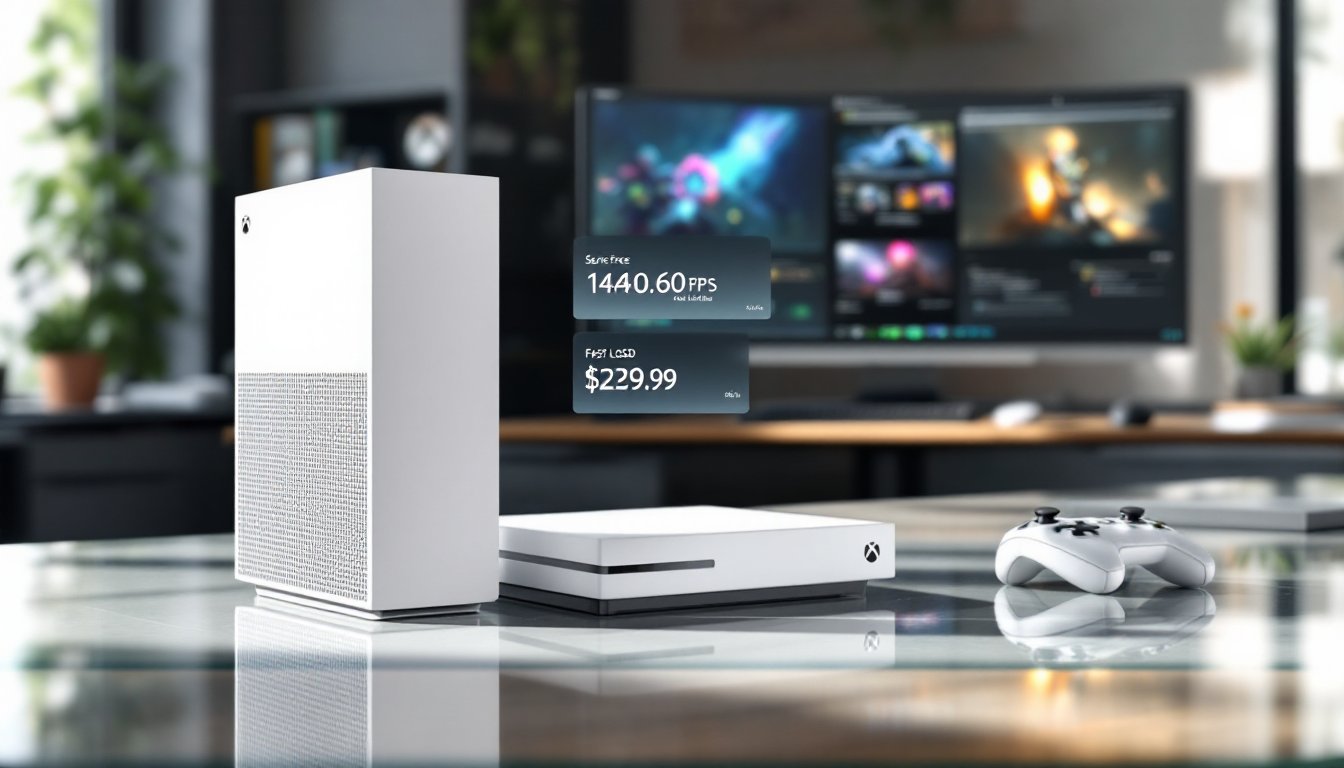
The Xbox Series S has quietly become Microsoft’s secret weapon in the current console generation. Released at $299.99, it’s the most affordable entry point into next-gen gaming, proving you don’t need 12 teraflops and a disc drive to have a genuinely compelling experience. Three years into its lifecycle, the Xbox Series S: The console is still relevant because it delivers on what matters: a solid game library, lightning-fast load times thanks to its custom SSD, and seamless access to hundreds of titles through Game Pass. For gamers tired of $500+ consoles and interested in 1440p gaming with 4K upscaling, the Series S remains one of the smartest buys in gaming.
Table of Contents
ToggleKey Takeaways
- The Xbox Series S delivers exceptional value at $299.99 with 1440p gaming at 60 FPS, making it the most affordable next-gen console without compromising on current-gen game performance.
- Xbox Series S owners gain access to four generations of games through backward compatibility, from original Xbox titles to the latest Series X|S releases, plus hundreds of additional games via Game Pass.
- Game Pass Ultimate at $17 per month transforms the Xbox Series S into a content powerhouse, providing day-one access to Microsoft first-party titles and cloud gaming that offsets storage limitations.
- The compact design and all-digital approach of the Xbox Series S eliminates disc drive failures while remaining 60% smaller than the Series X, ideal for gamers with limited space.
- Expandable storage via proprietary Storage Expansion Cards and external drives allows Xbox Series S users to manage the 512 GB internal SSD efficiently without sacrificing game library access.
- The Xbox Series S is the smart choice for budget-conscious gamers, those prioritizing 1440p visual quality over 4K, or anyone entering next-gen gaming who wants the best value-to-experience ratio.
What Makes the Xbox Series S Stand Out
Performance and Design
The Xbox Series S is purpose-built for 1440p gaming at 60 FPS, with capable support for up to 120 FPS in select titles. It shares the same CPU architecture as the Xbox Series X, an 8-core AMD Zen 2 processor running up to 3.6 GHz, but with a custom AMD RDNA 2 GPU pushing 4.0 TFLOPS versus the Series X’s 12.15 TFLOPS. That difference matters on paper, but in practice, most current-gen games look sharp on the Series S.
The standout feature is the design. At roughly 60% smaller than the Series X, it’s the most compact Xbox console ever made. The all-digital, disc-free approach cuts manufacturing costs and eliminates moving parts that can fail. Inside, 10 GB of GDDR6 RAM (8 GB high-bandwidth, 2 GB lower-bandwidth) keeps things humming. HDMI 2.1 support includes Auto Low Latency Mode and Variable Refresh Rate, so if you’ve got an AMD FreeSync monitor or TV, you’re getting adaptive sync without paying extra.
Audio capabilities include up to 7.1 L-PCM, Dolby Digital 5.1, DTS 5.1, and Dolby TrueHD with Atmos support, legit theater-grade audio processing. For a console that costs less than most graphics cards, that’s impressive.
An Extensive Game Library Across Four Generations
The Series S plays every Xbox Series X
|
S game released or coming out. That’s a growing catalog: Starfield, Forza Motorsport, Senua’s Saga: Hellblade II, A Plague Tale: Requiem, and literally hundreds more. The real magic? Backward compatibility.
You’re not locked into one generation. The Series S runs nearly all Xbox One games, most of which benefit from enhanced performance. Dig deeper, and you’ve got support for Xbox 360 and original Xbox backward-compatible titles. That’s four generations of games on one machine. Whether you want to replay Halo: Combat Evolved, jump into Gears 5, or tackle today’s AAA releases, you’re covered. This is why the Series S is underrated, the game library isn’t a weakness, it’s a strength. Most gamers don’t need 4K native: they need access to games they actually want to play.
Xbox Series S vs comparisons often highlight raw GPU power, but library depth tells a different story. The Series S owner has more to play than the PS5 owner, statistically speaking.
Why Xbox Game Pass Ultimate is a Game-Changer
Game Pass Ultimate is the reason the Series S hits different. For roughly $17 per month, you get hundreds of games across console, PC, and Xbox Cloud Gaming (xCloud). Day-one access to Microsoft first-party releases, Starfield on day one, not six months later, justifies the subscription alone.
Cloud gaming is the sleeper feature. You can play Series X-quality games on your Series S without downloading them, partially offsetting the console’s smaller storage footprint. It’s not perfect, latency matters for competitive shooters, but for single-player campaigns and relaxed multiplayer, it’s seamless. The value proposition is brutal: $299 console + $17/month subscription gives you access to a library that would cost $1,000+ to purchase outright. Game Pass essentially turns the Series S into a content consumption machine, and that’s exactly what casual to mid-core gamers want.
Storage, Accessories, and Expandability
The 512 GB internal SSD is tight. Windows-level bloat doesn’t apply here, the Xbox OS is lean, but a 150 GB AAA title means you’re managing storage within weeks. Here’s where expandability saves the day.
Seagate and Western Digital manufacture proprietary Storage Expansion Cards (up to 4 TB) that plug directly into the back of the Series S. They’re pricey compared to PC SSDs, but they work seamlessly. Series X
|
S games must run from internal or expansion SSD storage: the 1 TB model exists and addresses this pain point, though at a slightly higher price. USB 3.1 external drives work for backward-compatible games and media, so your old Xbox One library can live on cheaper external storage.
Accessories? The standard Xbox Wireless Controller works flawlessly, and most Xbox One controllers are compatible. Xbox One S all-digital experience proved Microsoft’s confidence in the gamepad-and-service model, and the Series S continues it. You’re not missing features or functionality compared to the Series X, just raw bandwidth.
Xbox Series S vs. Xbox Series X: Which Console is Right for You
The pitch is straightforward: Series S is for 1440p/120 FPS gaming: Series X is for native 4K and maximum visual fidelity. Here’s what matters:
Xbox Series X:
- Native 4K target, 12.15 TFLOPS GPU power
- 16 GB RAM, 1–2 TB SSD options
- UHD Blu-ray drive (physical media support)
- $499+ price point
- Faster ray-tracing performance
Xbox Series S:
- 1440p target with 4K upscaling, 4.0 TFLOPS
- 10 GB RAM, 512 GB/1 TB SSD options
- No disc drive, all-digital
- $299.99 entry price
- Compact form factor
Both share the exact same CPU architecture, Quick Resume, Auto HDR, and variable refresh rate support. Both play the same games. The Series X wins on raw graphical grunt and storage, but the Series S wins on value per dollar and physical footprint. Recent coverage from The Verge highlighted that most Series S owners report satisfaction with visual quality, contradicting early skepticism.
Choose the Series X if you have a 4K TV and want future-proofing. Choose the Series S if budget matters, space is limited, or 1440p is good enough (spoiler: it is for most people). Add Game Pass Ultimate, and the Series S becomes an insanely good value proposition for anyone except ultra-competitive esports players chasing frame-perfect performance at maximum resolution.
Conclusion
The Xbox Series S is Microsoft’s best-kept secret in 2026. It’s compact, affordable, and doesn’t compromise on the features that actually matter: backward compatibility, Game Pass access, and near-identical performance for current-gen games. For gamers skeptical of $500+ consoles or those dipping into next-gen for the first time, it’s the smart choice. If you’re looking for value without sacrificing experience, the Series S delivers.