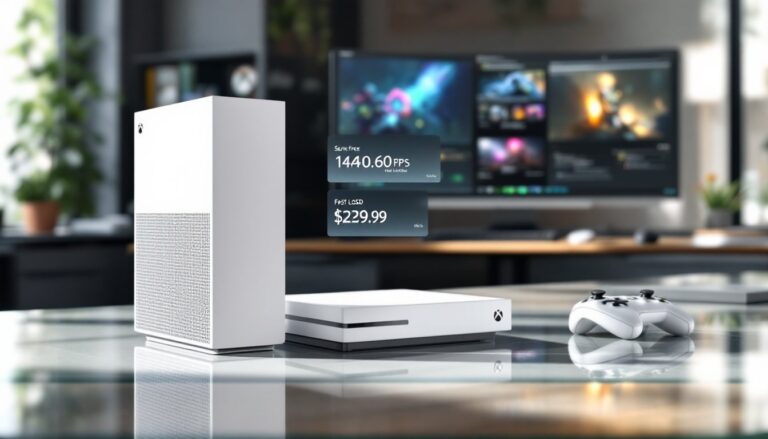
Even in 2026, the Xbox One X remains a topic of curiosity for gamers considering the Xbox ecosystem. Released in November 2017, this mid-generation console was Microsoft’s first serious attempt at 4K gaming, packing 6 TFLOPS of GPU power and a custom 8-core CPU. While newer hardware like the Xbox Series X dominates today’s market, understanding what the Xbox One X offered, and whether it’s still relevant, matters if you’re hunting for a budget-friendly entry point or a media machine. Let’s break down the specs, performance, and whether picking one up makes sense in 2026.
Table of Contents
ToggleKey Takeaways
- The Xbox One X, released in 2017 with 6 TFLOPS of GPU power and a custom 8-core CPU, was Microsoft’s first serious 4K gaming console, but is now considered obsolete as new games are no longer developed for it.
- On the used market, the Xbox One X remains a budget-friendly entry point into Xbox’s ecosystem, offering solid 4K UHD Blu-ray media playback and access to backward-compatible Xbox One, Xbox 360, and select original Xbox titles.
- While the Xbox One X delivered meaningful performance improvements over the base Xbox One with faster load times and enhanced frame rates for legacy games, it offers no exclusive titles and cannot handle demanding 2026 releases.
- For casual gamers prioritizing affordability and legacy gaming over cutting-edge performance, the Xbox One X works as a low-cost media machine, but the Xbox Series X is the recommended choice for future-proof console gaming.
What Is the Xbox One X and Why Does It Still Matter?
The Xbox One X was Microsoft’s answer to gaming’s 4K revolution. Unveiled in June 2017 and released that November, it was the company’s first console built from the ground up for premium 4K gaming and media playback. Unlike the base Xbox One, the Xbox One X delivered significantly more processing muscle without breaking compatibility, every Xbox One game and accessory worked seamlessly.
Why bring it up now? On the used market, the Xbox One X remains a low-cost entry into the Xbox ecosystem for casual gamers. Its 4K UHD Blu-ray drive doubles as a media powerhouse, making it a solid choice if you care about disc-based movies. More importantly, it runs the entire Xbox One and Xbox 360 backward-compatible library, plus a chunk of original Xbox titles, many available through Game Pass (where still supported). If you’re not chasing cutting-edge next-gen graphics, the Xbox One X still delivers something useful.
Hardware Specs and Performance Breakdown
To understand what the Xbox One X can actually do, you need the numbers:
Processor: 8-core custom CPU running at 2.3 GHz.
GPU: Custom graphics processor @ 1.172 GHz with 40 compute units, outputting ~6.0 TFLOPS.
Memory: 12 GB GDDR5 RAM with 326 GB/s bandwidth (roughly 9 GB available for games).
Storage: 1 TB HDD with 50% higher bandwidth than the base Xbox One.
Optical Drive: 4K UHD Blu-ray player.
Video Output: Native 4K (2160p) gaming and streaming: HDR support included.
Audio: Dolby Atmos and spatial audio for immersive sound.
Those specs might sound dated against the Xbox Series X, but they were genuinely premium at launch. The CPU-to-GPU balance was engineered to push 4K rendering while maintaining playable frame rates.
Processing Power and Frame Rates
The 6-teraflop GPU and faster memory setup allowed the Xbox One X to achieve what its predecessor couldn’t. Many “Enhanced for Xbox One X” titles delivered native 4K resolution or higher visual fidelity with HDR enabled. Frame rate consistency also improved, older Xbox One and 360 games could hit and maintain their engine-defined maximum frame rates more reliably because all that extra power stayed available for legacy code.
Load times were noticeably shorter compared to the base console, thanks to increased memory and storage bandwidth. A detailed hands-on review from launch coverage highlighted these performance jumps in real-world testing. For a mid-generation refresh, the engineering was solid, nothing revolutionary, but a meaningful step forward.
Game Library and Exclusive Titles
Here’s the straightforward part: the Xbox One X has no exclusive games. Zero. Every title released for the Xbox One X also runs on the base Xbox One, so you’re not locked into premium hardware to play anything.
What you do get is access to the entire Xbox One catalog, thousands of games spanning action, RPGs, shooters, indie gems, and more. Backward compatibility means Xbox 360 titles and a selection of original Xbox games run natively, often with improved performance. Top titles showing off the console’s capabilities include games that shipped with “Enhanced for Xbox One X” badges, featuring higher resolutions, better texture quality, or improved frame rates.
Game Pass, Microsoft’s subscription service, gives you access to hundreds of games on the Xbox One X, though newer Xbox Series-exclusive titles won’t be available. For someone building a library of established, proven games, that’s not a dealbreaker. For someone wanting to play 2026’s hot releases? You’ll hit a ceiling.
Is It Worth Buying in 2026?
Let’s be blunt: Microsoft stopped manufacturing the Xbox One X years ago. New games aren’t being developed specifically for it anymore. The console is officially considered obsolete in the eyes of the industry.
Compared to the Xbox Series X, the gap is massive. The Series X features a faster custom CPU, a vastly more powerful GPU, an NVMe SSD (instead of a spinning HDD), and support for Series-exclusive titles. A comprehensive look at the hardware evolution shows just how dated the CPU and storage architecture have become. If you’re spending money on a console in 2026, the Series X or Series S make far more sense for longevity.
That said, on the used market, the Xbox One X can be a bargain. If the price drops low enough, it works as a casual gaming machine plus a 4K Blu-ray player. It’s decent for playing through older franchises, Game Pass classics, or backward-compatible titles. Just don’t expect it to handle demanding new releases or provide a future-proof platform. Your gaming library won’t grow much beyond what already exists, and performance will trail current standards for demanding games.
Conclusion
The Xbox One X was a pioneering console, the first real push toward 4K gaming on a dedicated device. With 6 TFLOPS, 12 GB of GDDR5 RAM, and a 4K Blu-ray drive, it delivered genuine upgrades over its predecessor and proved Microsoft understood the demand for premium gaming hardware mid-cycle.
In 2026, it’s no longer a recommended primary purchase. The Xbox Series X offers far better performance and future support. But, as a used bargain for casual gaming, media playback, or a low-cost Xbox ecosystem entry point, it still has a niche. Make your decision based on realistic expectations: solid legacy gaming and media, but no cutting-edge performance or new game support.